Between October 12 and October 21, 2026, the GitLab, Next.js, PHP and Node.js projects each shipped a security release that fixes remote code execution (RCE), a flaw that lets an attacker run their own code on someone else's server, and the cloud platform Railway and the coding tool OpenCode each disclosed a breach that may have exposed their customers' stored secrets. GitLab fixed one RCE in each of two releases, Next.js and PHP fixed two each, and Node.js fixed one in the Brotli decoder it bundles. OpenCode also fixed a separate RCE flaw in September without publishing a CVE, and neither breach has a CVE either, so a vulnerability scanner will not list any of the three.
Two other disclosures of the same weeks are covered after the incidents, because they change how the numbers should be read: the NGINX fixes, and the eMudhra intermediate certificate authority (CA) compromise, which Go and Node.js both patched and which Chrome and Firefox answered by removing a root certificate.
Each project's own advisory or disclosure is the source for every figure below, and each is linked under Sources. Status lines, such as whether an attack has been reported, are as of October 23, 2026. The sections that follow list what each project fixed, which versions contain the fix, what is known about attacks, and how to check what a server is running.
The releases at a glance
| Project | Release date | Fixed versions | RCE fixes | Highest severity |
|---|---|---|---|---|
| Next.js | October 14 | 16.4.1, 15.5.28 | 2 | Critical |
| PHP | October 21 | 8.5.12, 8.4.27, 8.3.36, 8.2.35 | 2 | Critical, Common Vulnerability Scoring System (CVSS) v4.0 score 9.2 each |
| Node.js | October 21 | 26.12.1, 24.22.1, 22.23.4 | 1 | High by the Node.js project, CVSS v4.0 9.2 in the CVE record |
| GitLab | October 12 | 19.4.2, 19.3.5, 19.2.8 | 1 | Critical, CVSS v3.1 10.0 |
| GitLab | October 21 | 19.5.1, 19.4.3, 19.3.6, 19.2.9, 19.1.9, 19.0.10, 18.11.13 | 1 | Critical, CVSS v3.1 10.0 |
A Next.js server runs on Node.js, so one deployment can need two of these updates. PHP and GitLab are separate products from the other two.
The RCE fixes, in the order the sections below cover them:
- Next.js:
use cachefunctions returning typed arrays, Critical. - Next.js: Image Optimization with SVG, Critical.
- PHP: CVE-2026-109618, Critical.
- PHP: CVE-2026-109619, Critical.
- Node.js: the Brotli decoder, CVE-2026-111497, High.
- GitLab: CVE-2026-97229, Critical, fixed on October 12.
- GitLab: CVE-2026-110264, Critical, fixed on October 21.
The two breaches, Railway and OpenCode, follow the releases, because they have no version to update to and no CVE.
Next.js: the October 14 out-of-band release
Next.js published an out-of-band update on October 14, meaning a release outside the project's normal security schedule. The Next.js team announced it a week earlier, and said it included two fixes postponed from the September security release because of delays in upstream dependencies. The fixed versions are 16.4.1 on the Active long-term support (LTS) line and 15.5.28 on the Maintenance LTS line.
npm install next@15.5.28  # for 15.5
npm install next@16.4.1   # for 16.4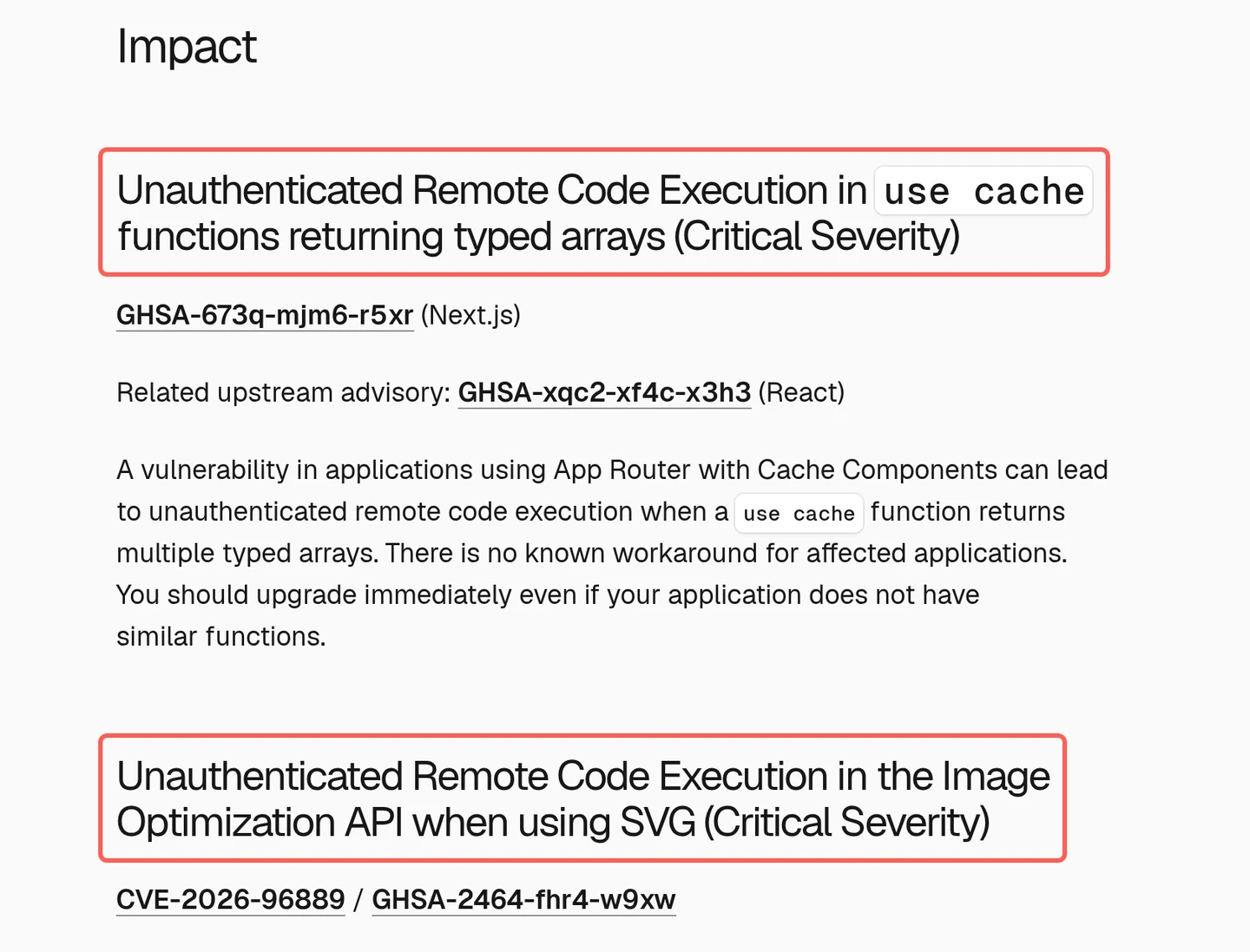
Cache Components and typed arrays
The advisory is GHSA-673q-mjm6-r5xr, a GitHub Security Advisory (GHSA) identifier, and its related upstream advisory in React is GHSA-xqc2-xf4c-x3h3. It is rated Critical.
An application that uses the App Router with Cache Components can be exploited for unauthenticated remote code execution when a use cache function returns multiple typed arrays.
The advisory states there is no known workaround, and says to upgrade immediately even if the application has no similar functions.
Image Optimization and SVG
This one is CVE-2026-96889, also tracked as GHSA-2464-fhr4-w9xw, and it is rated Critical.
A memory-related flaw in an upstream library used by the Image Optimization API can lead to remote code execution when Next.js runs on a Linux system that uses the glibc C library.
The advisory's title names Scalable Vector Graphics (SVG) as the condition.
The workaround is to make sure the version of sharp that Next.js uses is 0.35.5 or later; upgrading Next.js to a patched version makes the package manager provide a fixed sharp automatically.
Server Actions and denial of service
The release also fixes GHSA-p3m5-59mp-jv5r, a denial of service (DoS) rated High, with the related React advisory GHSA-h3gv-c5rc-p453. It is not an RCE, but it ships in the same update.
Crafted requests to an application that uses the App Router with at least one Server Action can cause excessive central processing unit (CPU) usage. That usage blocks the processing of further requests in the same process. Applications that use only the Pages Router, or that have no Server Actions, are not affected.
PHP: the October 21 release, reported as PHP2Shell
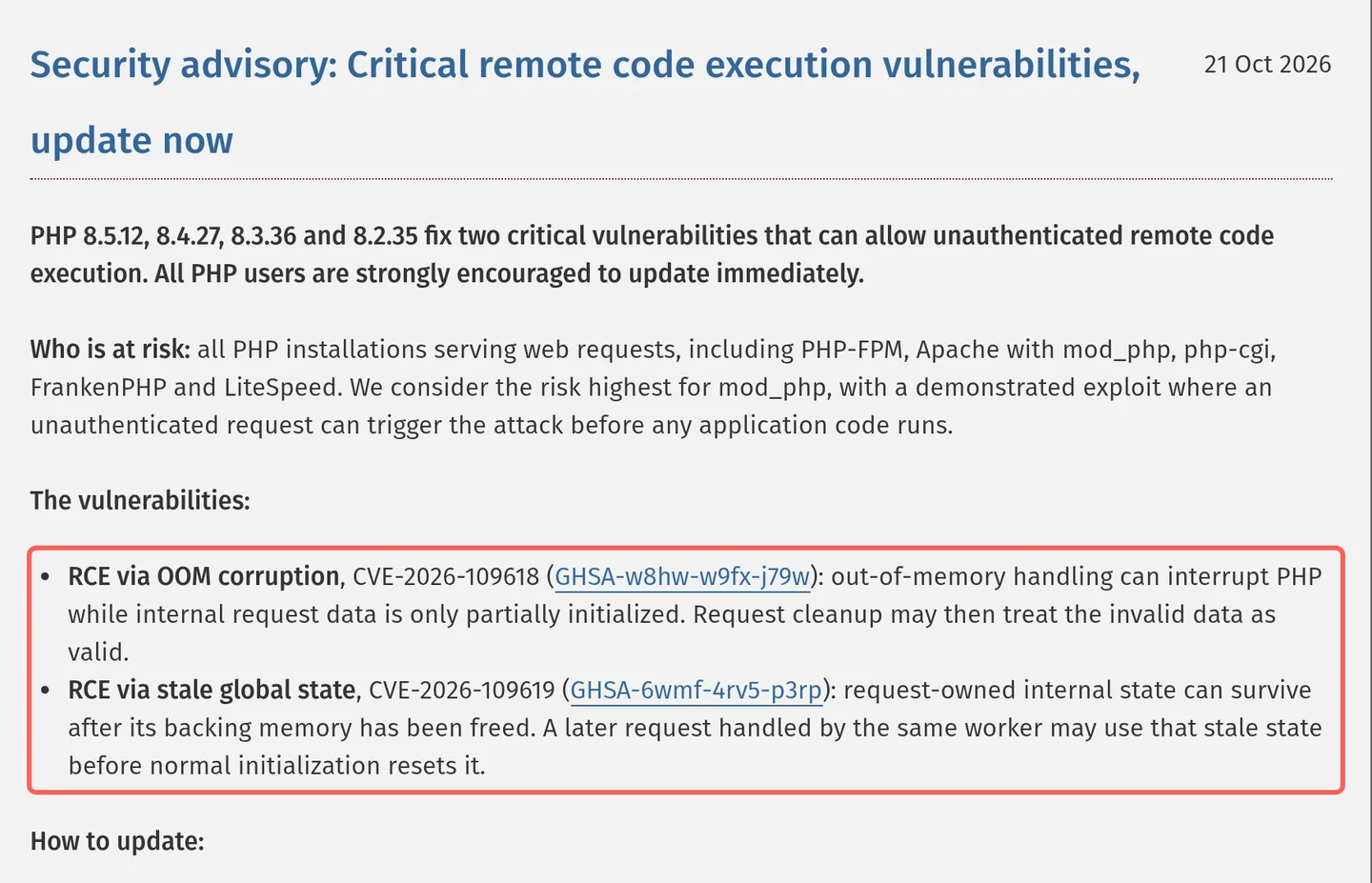
The PHP project announced an upcoming critical security release on October 20 and published it on October 21: PHP 8.5.12, 8.4.27, 8.3.36 and 8.2.35. Security vendors report the two bugs under the name PHP2Shell. Both are rated Critical, CVSS v4.0 9.2, and can allow unauthenticated remote code execution.
The two CVEs
| CVE | Class named by the advisory | What happens |
|---|---|---|
CVE-2026-109618 | RCE via out-of-memory corruption | An out-of-memory condition can interrupt PHP while request data is only partly initialised, and request cleanup may then treat invalid data as valid |
CVE-2026-109619 | RCE via stale global state | Request-owned internal state can survive after its memory is freed, and a later request on the same worker may use it |
Cisco Talos, which wrote its own analysis the same day, says the bugs are triggered by a plain HTTP request and are exploitable before any application code runs. It says every PHP build since 5.4 is affected, and that as of its post on October 21 at 14:00 Coordinated Universal Time (UTC) it had not seen them exploited in the wild. Talos also states that artificial intelligence and associated technologies played a key role in discovering the vulnerabilities.
Exploitation, disclosure and official guidance
Amazon Threat Intelligence reports a PHP2Shell exploitation attempt dating to October 17 in its honeypot telemetry, four days before the public release. The attempt came from an address on a commercial anonymization network, and Amazon says it is "unclear if any of these attempts would have succeeded in real-world systems". After the release, Amazon says, PHP2Shell was "seeing broad exploitation attempts in the wild". Cloudflare and the security firm watchTowr each report attack traffic as well, and watchTowr says its honeypots have seen exploitation since October 21. The Cloudflare and watchTowr pages give no count of attempts, and no source read for this page names a victim or confirms a successful compromise.
The Cybersecurity and Infrastructure Security Agency (CISA) of the US published its alert on October 21 and said it "has not observed exploitation of these vulnerabilities as of the time of publication". Neither CVE is in CISA's Known Exploited Vulnerabilities (KEV) catalogue in the file checked on October 23, which carries a release stamp of October 21 at 14:04 UTC. CISA's alert also says organizations that cannot update at once, or that still run PHP 8.1 or earlier, "should take PHP-based systems offline until they can be patched or updated".
The identifiers leaked early. The PHP Foundation says the two CVE numbers began circulating on forums and social media on October 20 at about 15:00 UTC, with a wrong release time and a wrong CVSS score of 10.0, and that the real score is 9.2. It says no technical details leaked at that point.
On how the bugs were found, the PHP Foundation says a core developer who was fixing an issue reported by the security firm Quarkslab found the first signs of the out-of-memory problem in 2024, and that the fix then stalled. Its own words are "the delay was a structural failure, caused by both the security team's decision process and its lack of resources". The Foundation says the security firm Calif reported an unconditional RCE with the same root cause on August 11, 2026, and that OpenAI independently reported the same root cause.
Affected setups and end-of-life versions
The PHP advisory names PHP-FPM (the FastCGI Process Manager), Apache mod_php, php-cgi, FrankenPHP and LiteSpeed as affected setups, with the risk highest for mod_php.
It says updating is the only complete fix.
PHP 8.1 and older no longer receive upstream updates, so the advisory points those users to their distribution or LTS vendor for backports. PHP 8.2 reaches end of life on December 31, 2026.
Interim mitigations
The advisory lists partial measures for servers that cannot update at once. It describes them as not a substitute for updating.
session.upload_progress.enabled = 0   ; CVE-2026-109619, restart all workers
post_max_size = 8M                    ; 32M if file uploads are required
fatal_error_backtraces = 0            ; PHP 8.5 only, restart all workers
The advisory also says memory_limit=-1 should be set in a way applications cannot override, that RLIMIT_AS and RLIMIT_DATA should not be used, and that the session setting should not rely on ini_set() or .user.ini.
Node.js: the October 21 release and the Brotli decoder
Node.js published security releases for the 26.x, 24.x and 22.x lines on October 21. They fix 10 vulnerabilities: 4 High, 3 Medium and 3 Low. The fixed versions are 26.12.1, 24.22.1 and 22.23.4.
The Brotli decoder flaw
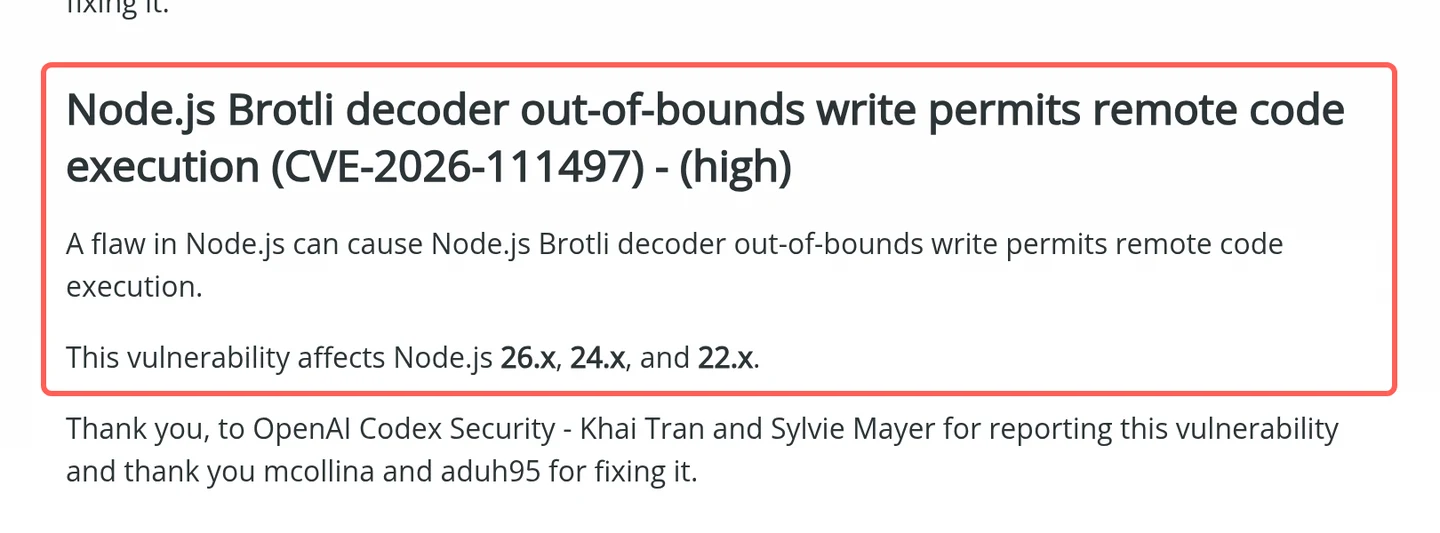
CVE-2026-111497 is rated High and affects the 26.x, 24.x and 22.x lines. The advisory describes it in one sentence: a Node.js Brotli decoder out-of-bounds write permits remote code execution. Brotli is a compression format, and the decoder is the code that unpacks compressed data. An out-of-bounds write means that code writes to memory outside the buffer it was given.
The advisory does not say what input triggers the bug, so this page does not either. OpenAI Codex Security, with Khai Tran and Sylvie Mayer, is credited with the report.
Node2Shell, severity and exploitation status
Imperva Red Team named its analysis of this flaw Node2Shell. The Node.js advisory does not use that name and calls the bug "Node.js Brotli decoder out-of-bounds write permits remote code execution".
Two primary sources rate the flaw differently. The Node.js advisory rates it high and gives no score. The CVE record, assigned by Google, carries a CVSS v4.0 base score of 9.2, Critical. The National Vulnerability Database had not scored the CVE when checked on October 23, and its only entry is Google's.
On exploitation, Imperva reports that its own proof of concept ran code carried in a Brotli request or response body inside applications on the official Node.js 24.22.0 Linux arm64 image, that "the proof did not succeed on every attempt", and that 24.22.1 rejects the same input. CISA's data in the CVE record lists exploitation as "none" as of October 22, and the CVE is not in the KEV file checked on October 23. No source read for this page reports an attack on a real server.
Imperva describes Express 5 and body-parser 2 as "routes into the vulnerable Node.js decoder, not the source of the flaw", and says: "Complete remediation requires updating Node.js." The decoder is part of the runtime, so updating an application's own packages does not change it.
All ten CVEs
| CVE | Issue | Severity | Affects |
|---|---|---|---|
CVE-2026-105482 | dns.resolve truncates names containing a null character (NUL) | High | 26.x, 24.x, 22.x |
CVE-2026-105483 | Transport Layer Security (TLS) certificate hostname bypass when the IP is written in fullwidth digits | High | 26.x, 24.x |
CVE-2026-106069 | TLS certificate hostname bypass when the host loosely resolves to an IP address | High | 26.x, 24.x, 22.x |
CVE-2026-111497 | Brotli decoder out-of-bounds write permits remote code execution | High | 26.x, 24.x, 22.x |
CVE-2026-105481 | A keep-alive socket processes a response that was written before the request was sent | Medium | 26.x, 24.x, 22.x |
CVE-2026-106072 | Improper certificate validation for non-canonical IPv4 hostnames lets DNS names authenticate IP endpoints | Medium | 26.x, 24.x, 22.x |
CVE-2026-106074 | crypto.randomUUID() and randomInt() entropy caches are saved into startup snapshots, so every process repeats the same values | Medium | 26.x, 24.x, 22.x |
CVE-2026-106070 | ZipFile returns attacker-controlled prefix bytes after a failed header validation | Low | 26.x |
CVE-2026-106071 | Permission Model filesystem over-grant through a wildcard lookup | Low | 26.x |
CVE-2026-106073 | Permission Model bypass with fs.realpathSync | Low | 26.x, 24.x, 22.x |
The release also updates bundled dependencies: c-ares and Undici on all three lines, OpenSSL on 24.x and 22.x, and SQLite on 22.x. End-of-life Node.js versions are always affected when a security release happens, and the project does not patch them.
GitLab: the October 12 and October 21 critical patch releases
GitLab published two Critical Patch Releases nine days apart, and each includes one flaw that GitLab rates Critical, CVSS v3.1 10.0, the top of the scale. GitLab describes both as an issue that, "under certain conditions", "could have allowed an unauthenticated user to execute arbitrary code on the GitLab server". Both are integer overflows in how GitLab handles regular expressions, and both credit the same researcher, who reported through GitLab's HackerOne bug bounty program.
| Release | CVE | Where the flaw is | GitLab's score | Affected versions |
|---|---|---|---|---|
| October 12 | CVE-2026-97229 | The regular expression compiler, reached through a project's build-pipeline configuration | 10.0 | 19.2 before 19.2.8, 19.3 before 19.3.5, 19.4 before 19.4.2 |
| October 21 | CVE-2026-110264 | The regular expression compiler | 10.0 | All versions from 7.0 before 18.11.13, plus 19.0 before 19.0.10, 19.1 before 19.1.9, 19.2 before 19.2.9, 19.3 before 19.3.6, 19.4 before 19.4.3 and 19.5 before 19.5.1 |
Both releases cover the Community and Enterprise editions of GitLab. GitLab.com already runs the patched version, and for the October 21 release GitLab says "we strongly recommend that all self-managed GitLab installations be upgraded to one of these versions immediately". The release notes list twelve security fixes for October 21 with GitLab's own rating on each: one Critical, two High, five Medium and four Low.
The October 21 notes say the patch includes database migrations, so a single-node instance has downtime during the upgrade, and a multi-node instance can avoid it with zero-downtime upgrade procedures. The page gives no workaround for CVE-2026-110264. It links two threat detections for self-managed instances, and their pages warn that the absence of a hit never clears an attempt or a success.
On exploitation, the release page does not say the flaw is being used in attacks. CISA's data in the CVE record lists exploitation as "none" as of October 21, and CVE-2026-110264 is not in the KEV file checked on October 23. Public proof-of-concept repositories for it appeared on GitHub on October 22 and 23, and this page links none of them and did not run any.
To read the version of a self-managed instance, sign in, open Help at the bottom of the left sidebar, and read the version at the top of the page. The first two numbers are the branch, which is the row to compare against the fixed versions above.
Railway and OpenCode: two breaches without a CVE
A CVE identifies one flaw in one product, so it exists only when a disclosure names such a flaw. Neither Railway nor OpenCode named a flaw in its breach disclosure, so neither breach has a CVE or a score, and the remedy is rotating secrets, since there is no patch to install.
Railway: the October 21 disclosure
Railway is a platform that hosts and deploys applications for its customers. On October 21 it posted that it "detected anomalous activity involving systems that store customer environment variables", and that an unauthorized third party "may have accessed encrypted environment variables and, for some of them, obtained the decrypted contents". Environment variables are the settings an application reads at startup, and they often hold application programming interface (API) keys, database credentials and private registry credentials.
Railway paused all deployments, told every user to roll every environment variable stored on the platform, and notified upstream providers so they can revoke keys. It also recommends reviewing logs for those services for unusual activity. Its initial analysis suggests the impact "may be limited to a subset of users", and it gave no number. It will email the customers it confirms as affected.
Railway believes the incident is part of a series of attacks on platform companies "with the aim of compromising" artificial intelligence (AI) inference providers. That is Railway's own reading, and the disclosure does not say how the access happened or who did it. On October 22 it published two follow-up recommendations, titled as checks for anomalous access in Google Cloud and in Amazon Web Services accounts.
OpenCode: the Console breach
OpenCode is an open-source AI coding agent, and its hosted Console lets users link keys from outside AI providers. On October 17 the project said it "had a security breach last night related to a large-scale distillation attack that impacted 1.4% of OpenCode Console users", the subset who had external providers linked, and that it had emailed them. Distillation is training a smaller model on the answers of a larger one, and it becomes an attack when the answers are collected through unauthorized queries. OpenCode has not explained how the breach and the distillation connect.
According to BleepingComputer, the email says the earliest possible exposure of the keys was October 17 at 00:30 UTC, and that OpenCode is working with Google, OpenAI and Anthropic. BleepingComputer also reports that OpenCode's co-founder said attackers had targeted its systems for at least 48 hours using AI agents. Users report unauthorized charges from several hundred dollars up to $1,700, and some report that Google suspended their projects for "abusive activity consistent with hijacked resources". Those figures are user reports, not confirmed totals.
OpenCode: the remote code execution flaw fixed without a CVE
Separately, Pillar Security reported a critical flaw in the OpenCode software itself.
OpenCode connects to servers that speak the Model Context Protocol (MCP), a protocol that lets an AI coding tool use outside tools, and a remote server can ask the user to sign in through OAuth.
During that sign-in, the server tells OpenCode which address to open, and Pillar found that on Windows and Windows Subsystem for Linux (WSL) the address went unescaped into PowerShell, which runs any $(...) expression inside it.
A malicious remote MCP server that a developer connects could therefore run code on the developer's machine with no further click.
| Item | What Pillar's report says |
|---|---|
| Affected versions | 1.0.137 through 1.18.32, on Windows and WSL |
| Fixed version | 1.18.33, published to npm on September 28 |
| Reported to the vendor | August 29, through a private GitHub advisory |
| Vendor response | The company said malicious MCP servers are "outside our threat model", merged the fix as a refactor, and published no advisory and requested no CVE |
| Score | A proposed CVSS v3.1 9.8, assigned by the researchers and not tied to a CVE |
Pillar's point is that scanners match on CVE numbers, so an installation of an affected version will not appear in a scan or a dependency alert. Its advice is to upgrade to 1.18.33 or later, to inventory OpenCode installations directly, and to remove untrusted remote MCP servers from the configuration where an upgrade is not possible. The two OpenCode incidents are separate: the Console breach was an intrusion into a hosted service, and the MCP flaw is in the program that runs on a developer's own machine.
What each disclosure asks of its users
- Railway: roll every environment variable and private registry credential stored on the platform, then review the logs of those services.
- OpenCode Console: a user who received no email from OpenCode was not affected, according to its statement. A user who did should rotate the linked provider keys and check each provider's billing and project status.
- OpenCode on Windows or WSL: check the installed version against 1.18.33.
The eMudhra intermediate CA compromise
On October 17, 2026, eight intermediate certificates issued by eMudhra, an Indian certificate authority, were found to be weak and were revoked. Go shipped a fix on October 20, and Node.js included one in its October 21 releases above. On October 20, Mozilla and Chrome went a step further and announced the removal of the root certificate that signed the eight, and by October 22 eMudhra had said it is leaving the global TLS certificate business.
What was compromised
BleepingComputer reports that a researcher known as Wayne found the weakness on October 17 while scanning public certificate data, and that eMudhra then revoked the affected certificates. All eight used P-384 private keys generated in April 2025, and the key values were so small that an attacker could recover one by testing just 256 possible numbers. A researcher published one such key, and BleepingComputer confirmed it matched a revoked certificate.
eMudhra blamed an error in a script used to generate the certificates.
The error produced a second, weaker set of keys that were chosen for signing by mistake, because their labels resembled those of the properly generated keys.
eMudhra said most of the affected intermediates were never used in production, and that it found no evidence they were used to issue certificates to end users.
Its own table in the Mozilla incident thread lists all eight as revoked on October 18 with the reason cACompromise.
The report adds that the keys could have been recovered since April 2025, and that there is no evidence this happened.
Root and intermediate certificates
A root certificate is self-signed and has no parent, and it serves as the trust anchor of a chain. An intermediate certificate is signed by a root or by another intermediate, and its only use is to sign other certificates. The Node.js advisory, the Go issue and BleepingComputer's report all describe intermediate certificates, and none of them reports a root certificate as compromised, so the first fix was blocking eight specific intermediates. The root removal described below came after that, and Mozilla's stated reason for it is a gap in how some clients handle revocation, not a compromise of the root itself.
Who blocked it, and how
| Project or vendor | Date | What it did |
|---|---|---|
| Mozilla | October 17 | Blocked the certificates through OneCRL, its list of revoked intermediate certificates, which needed no browser update or restart |
| Google Chrome | October 17 | Blocked six of the compromised intermediates that were authorised for TLS |
| Apple | October 19 | Added protections, with no details given in the report |
| Mozilla | October 20 | Announced "the emergency removal of trust in emSign ECC Root CA - G3", the root that signed the eight, and said it is not removing trust in emSign Root CA - G1 |
| Google Chrome | October 20 | Committed to the same path, and removes the same root from the Chrome Root Store, which Google expects to reach devices on October 27 |
| Go | October 19 to 20 | Verify now filters out any chain that contains these intermediates, tracked as CVE-2026-111943 on the project's urgent security track |
| Node.js | October 21 | The ca-cert dependency update in the three security releases, listed in the advisory as "eMudhra Intermediate CA Compromise" |
The Go fix is in Go 1.27.3 and Go 1.26.10, according to BleepingComputer's table of fixes. The Go issue itself says only that the project is blocking trust in a small set of intermediate certificates because of specific security concerns around their operation.
Software that has its own certificate store, or that does not check revocation, can keep trusting the certificates until it is updated. That is why Go and Node.js needed releases while the browsers could block the certificates remotely.
The root removal and eMudhra's exit
Mozilla wrote in its incident thread on October 20 that "multiple individuals have independently recovered the private keys for these intermediates", some of them publicly. After talking with maintainers of software that depends on Mozilla's root store, it decided to remove trust in the root, which "will protect clients which do not use revocation information or lack a mechanism to withdraw trust in specific intermediates". Google's Chrome Root Program said in the same thread that Chrome would follow a similar path. The Google Security post says: "Some legitimate certificates chaining to this root will cease to function in Chrome as a result." Website operators with a certificate under that root need a new one from a different certificate hierarchy, which Google says they must obtain immediately.
eMudhra answered on October 20 that it had stopped issuing from every intermediate under the root, and estimated that about 30,000 certificates need to move, about 97% of them issued through automated issuance.
It is moving subscribers to certificates under its Rivest-Shamir-Adleman (RSA) root, emSign Root CA - G1, which Mozilla is keeping for now.
A comment in the Mozilla thread dated October 22 quotes an eMudhra press release saying the company has decided to withdraw from the global TLS certificate business, and that it will replace affected customers' certificates free of cost through partners.
The most recent comment, on October 23, asks eMudhra or its hardware vendor for a technical explanation of how certified key-generation hardware produced such weak keys, and no answer was in the thread when this page was updated.
Reading severity across projects
A single total of CVEs across projects mixes ratings and can count one incident twice, so each project's own rating is listed here instead.
| Project | Release | Entries | Critical | High | Medium | Low | Rated by |
|---|---|---|---|---|---|---|---|
| Next.js | October 14 | 3 | 2 | 1 | 0 | 0 | The Next.js team |
| PHP | October 21 | 2 | 2 | 0 | 0 | 0 | The PHP project, CVSS v4.0 9.2 each |
| Node.js | October 21 | 10 | 0 | 4 | 3 | 3 | The Node.js project, which rates CVE-2026-111497 High while the CVE record scores it CVSS v4.0 9.2 |
| GitLab | October 12 | 24 | 1 | 5 | 14 | 4 | GitLab, before the October 14 to 21 window |
| GitLab | October 21 | 12 | 1 | 2 | 5 | 4 | GitLab |
| NGINX | fixed in 1.30.6 and 1.31.7 | 5 | 0 | 0 | 5 | 0 | nginx.org |
| Go | October 19 to 20 | 1 | not stated | not stated | not stated | not stated | The Go issue gives no score |
Four things change how this table reads.
- The same incident can be counted twice. The Go CVE-2026-111943 and the Node.js
ca-certupdate both belong to the eMudhra intermediate CA compromise, so it is one incident with two fixes, not two separate problems. - Who rates a flaw changes the rating. nginx.org lists CVE-2026-15176, CVE-2026-93479 and CVE-2026-97205 as medium, while the Health Information Sharing and Analysis Center (H-ISAC) bulletin on F5's own October 14 advisory lists the same three as Critical, CVSS 9.2. F5's advisory covers 11 NGINX vulnerabilities in all.
- A release date outside the week still shows up in a roundup. GitLab's first critical patch release came out on October 12, and it fixed 24 vulnerabilities with one rated Critical.
- A breach has no row. Railway and OpenCode are left out of the table because neither disclosure has a CVE or a rating, and the 9.8 that Pillar proposes for the OpenCode flaw is the researchers' own score.
Checking what a server runs
Compare the installed version against the fixed versions in the first table.
node --version
php --version
npm ls next
The three commands read three different things.
node --version prints the Node.js runtime, php --version prints the PHP build, and npm ls next prints the Next.js version that a project actually installed, which can differ from what package.json asks for.
GitLab and OpenCode are checked differently.
On GitLab, the version is under Help in the left sidebar of a signed-in self-managed instance, and on GitLab.com the page is gitlab.com/help.
OpenCode has no CVE to scan for, so compare the installed version with 1.18.33 on any Windows or WSL machine.
A server built from a container image needs a rebuilt image, since the old image keeps the old runtime until it is replaced. PHP on a Linux distribution may carry a backported fix under an older version number, and in that case the distribution's own advisory is the one to read.
Sources
- Next.js: Next.js Security Update for Upstream Vulnerabilities, October 14, 2026. Advisories: GHSA-673q-mjm6-r5xr, GHSA-2464-fhr4-w9xw, GHSA-p3m5-59mp-jv5r.
- PHP: the October 21, 2026 announcements on php.net (the security advisory and the releases of PHP 8.5.12, 8.4.27, 8.3.36 and 8.2.35), and Cisco Talos, Two critical RCEs in PHP core.
- Node.js: Wednesday, October 21, 2026 Security Releases.
- eMudhra: BleepingComputer, Mozilla, Google, Apple block compromised eMudhra CA certificates, and the Go issue, crypto/x509: mitigation for security concerns with a specific Certificate Authority.
- Severity table: GitLab critical patch release of October 12, 2026, the nginx.org security advisories, and the H-ISAC bulletin on F5's NGINX advisory.
- PHP2Shell, exploitation and disclosure: Amazon Threat Intelligence identifies PHP2Shell exploitation prior to public disclosure in MadPot, CISA, Critical Vulnerabilities in PHP Require Immediate Patching, and the PHP Foundation, Today's PHP Security Release, and How We're Strengthening PHP Security.
- Node2Shell: Imperva Red Team, Node2Shell: From Brotli Data to Remote Code Execution.
- GitLab: GitLab Critical Patch Release: 19.5.1, 19.4.3, 19.3.6, 19.2.9, 19.1.9, 19.0.10, 18.11.13 (October 21, 2026), and the October 12 release listed under the severity table.
- Railway: Security Disclosure: Wednesday October 21st.
- OpenCode: BleepingComputer, OpenCode hack exposes API keys amid AI distillation attacks, and Pillar Security, Open and Shut: Remote Code Execution in opencode via MCP OAuth.
- eMudhra root removal: Google Security, Protecting Chrome and Android Users from Compromised eMudhra Intermediate CA Certificates, and the Mozilla incident thread, eMudhra: Private key compromise of Intermediate Certificates.
- Certificates: Wikipedia, Public key certificate, for the root and intermediate definitions.